
Freya Russell · 15 October 2026
How Topology Awareness Influences Data Placement Decisions in Large Scale Caching Architectures
Network topology awareness plays a central role in how large scale caching architectures decide where to store and replicate data across nodes, and researchers continue to examine these dynamics in distributed environments. Topology refers to the physical and logical connections between cache servers, including latency measurements, bandwidth capacities, and proximity metrics that define communication costs between locations. Data placement algorithms incorporate these details to minimize retrieval times while balancing load across the network, and studies show that ignoring topology leads to higher miss rates and increased cross region traffic.
Core Concepts of Topology in Caching Networks
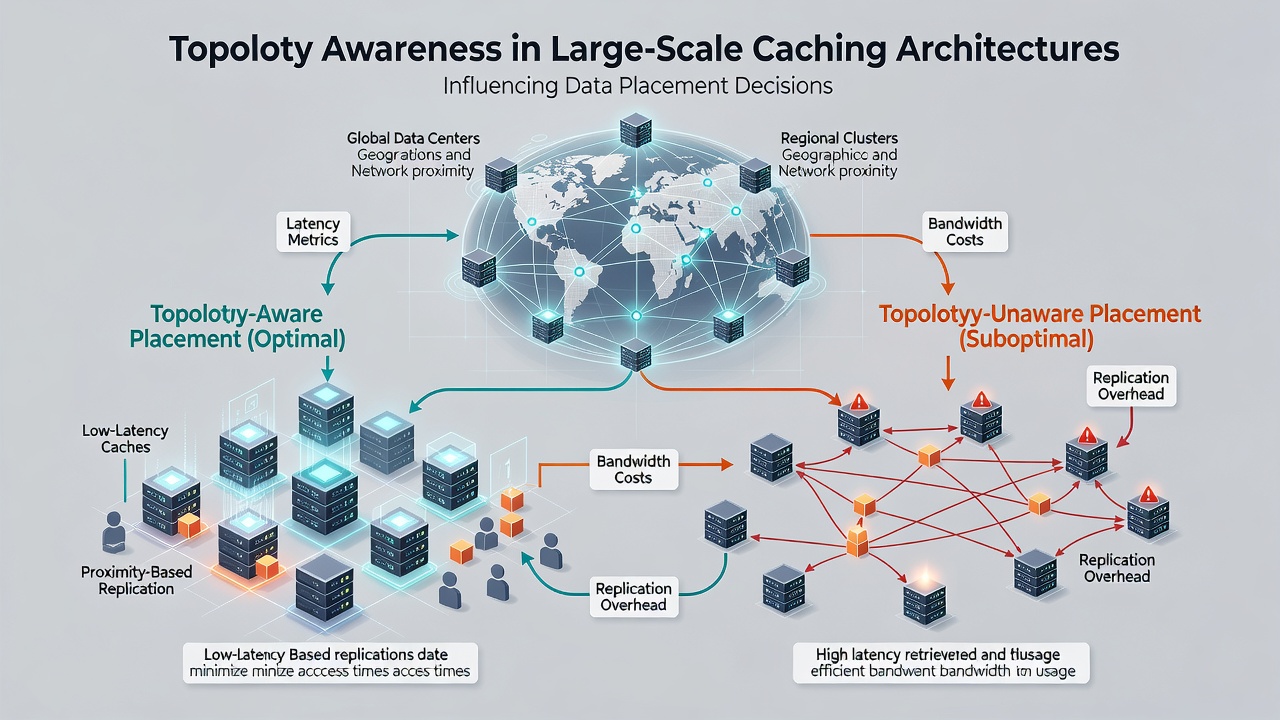
Cache systems in large deployments rely on maps that capture node relationships, such as hierarchical layers where edge caches sit closer to users and core caches handle regional aggregation. Topology aware placement evaluates distances in terms of hops or measured round trip times rather than treating all nodes as equal, which allows decisions that favor nearby replicas when demand patterns shift. Data shows that systems using full topology graphs achieve better hit ratios because they account for bottlenecks that simple consistent hashing overlooks, and observers note this becomes especially relevant as cluster sizes grow beyond hundreds of nodes.
Placement decisions often begin with monitoring tools that collect metrics on link utilization and failure domains, feeding this information into placement policies that replicate hot objects along high bandwidth paths. While basic replication might duplicate content everywhere, topology awareness restricts copies to strategic points that cover user clusters without flooding low capacity links, and evidence from deployments indicates reduced backbone congestion as a result. In October 2026 researchers presented updated models at international conferences that refine these policies for dynamic topologies where nodes join or leave frequently.
Algorithms and Decision Frameworks
Modern frameworks integrate topology data through cost functions that assign weights to potential storage locations based on predicted access latency and transfer expenses. One common approach builds spanning trees from the topology graph to guide replication toward leaves that serve dense user populations, whereas another uses greedy selection to place objects at nodes with the strongest connectivity to multiple demand sources. Researchers discovered that combining both methods yields stable performance when traffic spikes occur in specific geographic zones, and figures from production systems reveal measurable drops in average fetch times.
Load balancing modules work alongside placement logic to prevent any single node from becoming a hotspot, adjusting decisions when topology changes like link failures reroute traffic flows. Those who've studied these interactions point out that real time topology updates prevent stale placements that could otherwise degrade service during maintenance windows or regional outages, and case studies highlight how automated reconfiguration maintains performance without manual intervention.
Impact on Performance Metrics
Performance data collected across multiple deployments shows that topology aware placement improves cache hit ratios by directing replicas toward areas of concentrated demand while avoiding unnecessary copies in sparse regions. Bandwidth savings appear as another outcome because objects travel shorter distances on average, and this effect compounds when systems handle petabyte scale content libraries with varying popularity distributions. Observers note that latency sensitive applications benefit most since placement can prioritize low delay paths identified through continuous probing.
Scalability tests further demonstrate that these strategies maintain efficiency as node counts increase, provided the topology discovery process scales without introducing excessive overhead. Data from industry reports indicates that organizations adopting such methods report more predictable resource usage patterns, particularly when user bases span multiple continents with uneven connectivity quality.
Implementation Considerations Across Environments
Deployment teams integrate topology awareness through APIs that expose network maps to cache management layers, allowing policies to react to both static infrastructure details and dynamic conditions like congestion events. Integration with orchestration platforms enables automatic adjustments when new nodes appear or existing connections degrade, and this flexibility proves useful in cloud hybrid setups where on premises and remote resources coexist. Studies indicate that careful calibration of update frequency prevents oscillation in placement choices while still capturing meaningful changes.
Security considerations enter the picture as well because topology information itself requires protection against tampering that could misdirect data flows, and standards bodies have published guidelines on authenticated discovery protocols. Those implementing these features often combine them with access controls to limit exposure of internal network structures, ensuring placement decisions remain reliable even under adversarial conditions.
Conclusion
Topology awareness shapes data placement by providing the contextual details needed for efficient replication and retrieval in expansive caching networks, and ongoing research continues to refine how these inputs translate into actionable policies. As architectures evolve with new connectivity options and traffic patterns, the ability to incorporate accurate topology remains a foundational element for maintaining performance at scale, with evidence pointing to sustained benefits across diverse operational settings.